What's missing isn't knowledge. It's the belief that, together, we can do something about the future.
Social, environmental, political and economic, all at the same time, and all landing on the generation now in school.
Most people believe there is little or nothing they can do about it, or that what they do doesn't matter.
We face unprecedented challenges at the very moment we have more knowledge, tools and energy than ever. What's missing is the bridge between the two.
Áurea Terra doesn't create solutions to the crisis. It creates a system of learning, collaboration and creativity in which children build their own solutions, and grow, along with their communities, as they do it. Education that builds an empathetic bridge to the problems, and a bridge of collaboration, creativity, resourcefulness and celebration to the solutions.
When children solve a real problem in their territory, the river gets cleaner, yes. But what stays is the experience of agency: knowing they can. And it spreads, to their families, their teachers, their neighbours.
The return is intrinsic: an investment in a problem that only gets more expensive if we leave it alone.
Disconnected from a world they're told has no future.
It isn't one cause but the sum of several: learning that never touches the place they live (the Nile and giraffes, not the hummingbird in their own garden), screens used as an escape, and a constant stream of stories saying the world makes no sense, that it's ending, that nothing they do will change it. In some children it shows as worry, in others as apathy or lack of motivation, and in the most serious cases as depression.
Áurea Terra is not a mental-health treatment. It builds what protects children: belonging, purpose, and the lived experience that they can act.
Seven missions that rebuild the connection, one principle at a time, in their own territory: their river, their birds, their elders. Children discover that they matter, that they belong to something bigger, and that they can do something real for it.
No time to create new content.
Teachers are asked to build socioemotional skills and run environmental projects on top of everything else, with no time to prepare new material, and less still to adapt it to their own community.
The missions arrive ready, written for their territory and aligned with the curriculum. A teacher copilot shows how the class is doing, which child needs attention, and how to handle the delicate moments. We train them and stay by their side.
Teaching skills for a world that no longer exists.
Technology is taking a central place in children's lives, but it often keeps them on a screen, far from their surroundings and from each other. Schools know the future asks for something different, without a clear way to teach it.
Technology that sends children outside. The screen guides; the learning happens in the territory, with the community. Children practise what an uncertain future asks for: agency, collaboration, creativity and care.
A story where children become the heroes of their own place.
- UniquenessEach child discovers their own gift, and learns to see the unique gifts of a plant, an animal, a classmate.Self-worth
- BelongingThey map the bigger system that holds them: their river, their town, their elders. I am because we are.Gratitude
- InterdependenceThey follow how water, birds and people depend on each other, and find what needs care.Empathy
- Meaningful connectionThey match their gifts to a real need nearby: “Where can I make a difference?”Purpose
- Symbiotic collaborationIn teams, they combine their gifts and design one action together.Collaboration · creativity
- Creation with purposeTheir Action of Hope: planned, carried out, achieved. For real.Agency
- CelebrationThey share it with their community and reflect on what changed, in them and around them.Meaning
What is an Action of Hope?
It is what makes Áurea Terra different from any other program: a real action that the children design and carry out themselves, in their own place, for something they care about. Not an exercise on a screen. Something the whole town can see.
Real ideas from the children in our first prototype.
Tested in a real school, and it wants to do it again.
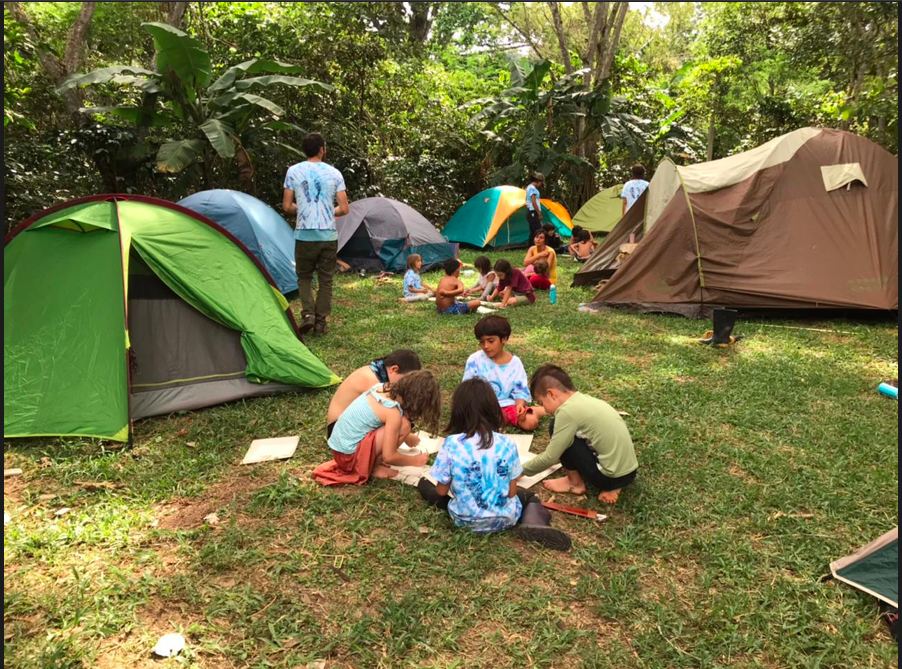
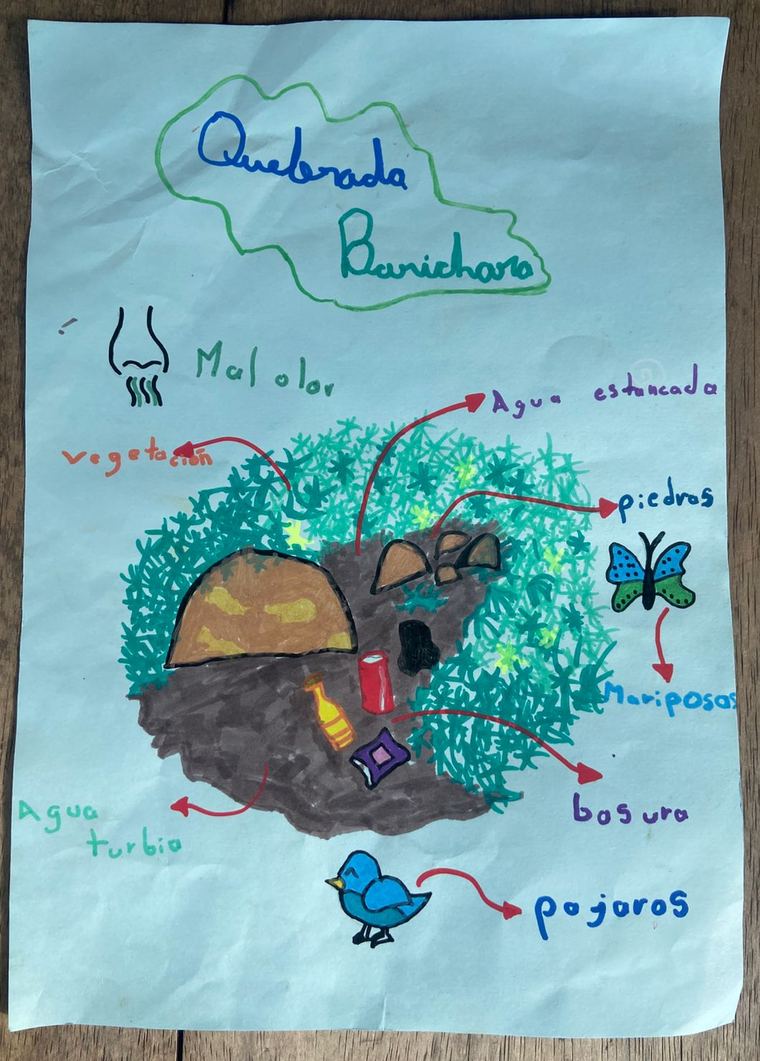
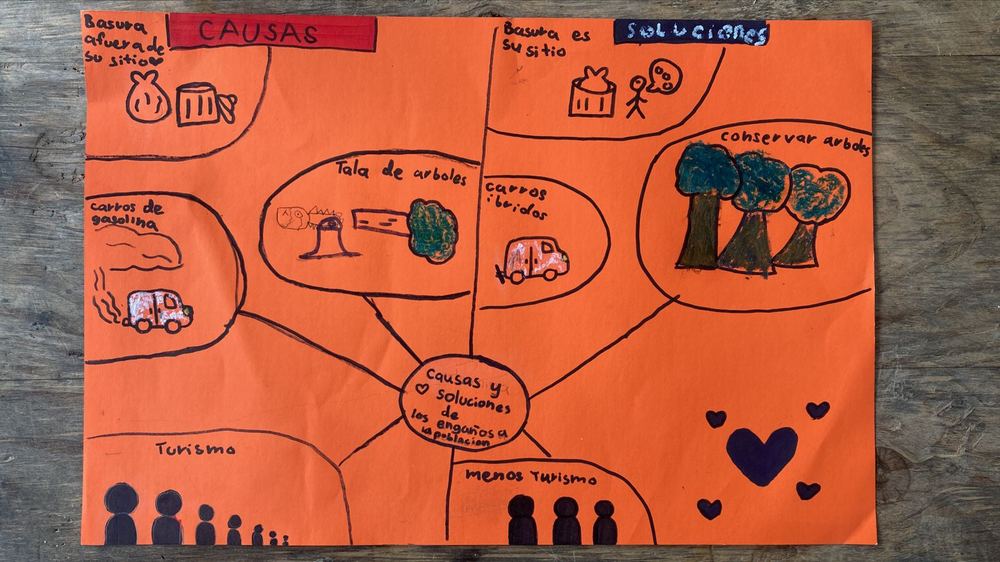
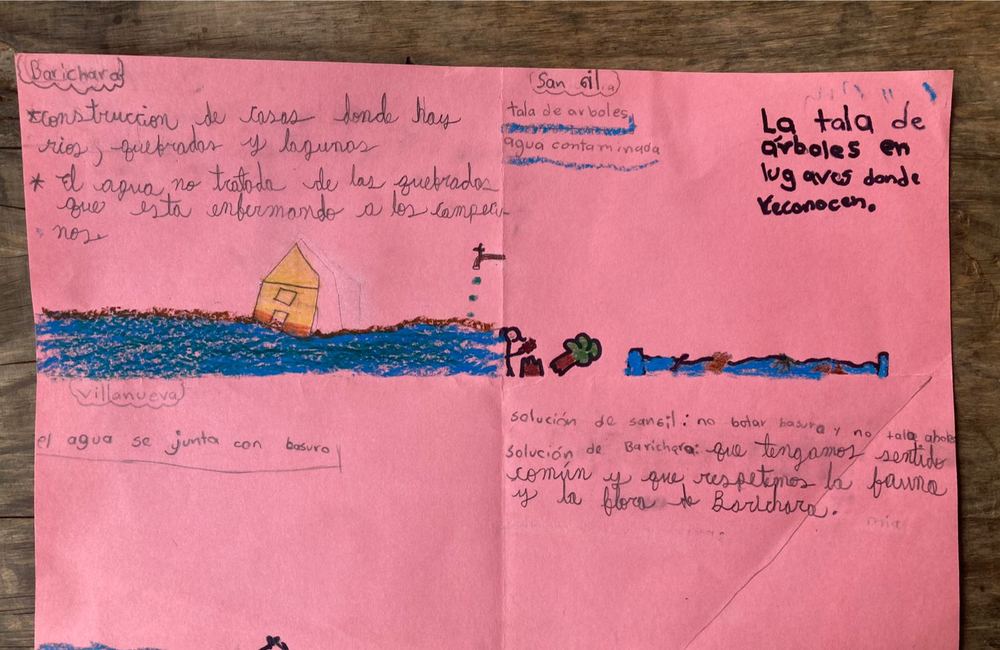
- A working platform in Spanish and English: the children's adventure, a field notebook, and the seven missions.
- A teacher copilot that shows the pulse of the class and flags the delicate moments of each mission.
- School onboarding in hours: a school describes its territory and AI drafts the missions in its own story, reviewed by our team.
- The compass: simple tools to follow hope, belonging and agency before, during and after the journey.
Run by Corporación Origen Circular, a registered, externally audited non-profit in Colombia. Prototype outcomes are qualitative, observed by teachers and our team.
A team between Barichara and Barcelona.
Corporación Origen Circular runs the program in the territory, with the schools and teachers. The product team builds and maintains the platform.
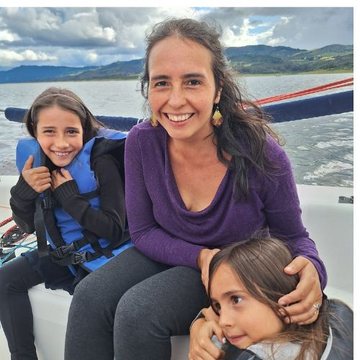
María Alejandra Camargo
Co-director · Origen CircularEcologist bridging science, traditional knowledge and maternal health. She integrates scientific rigor with ancestral wisdom to create holistic approaches to community wellbeing and ecological restoration, and leads the educational side of Origen's projects.
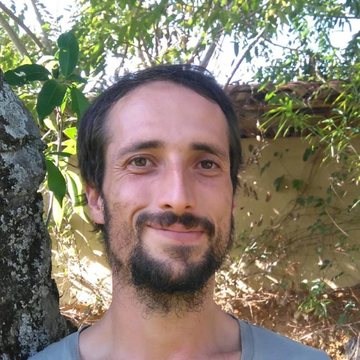
Felipe Medina Poch
Co-director · Origen CircularColombian educator and socioecological innovator, trained in conflict transformation, deep ecology and the design of complex systems for peace and regeneration. He helped create Work that Reconnects Colombia and leads initiatives such as Evoluma, Pasos de Agua and SUNA. He lives in Barichara.
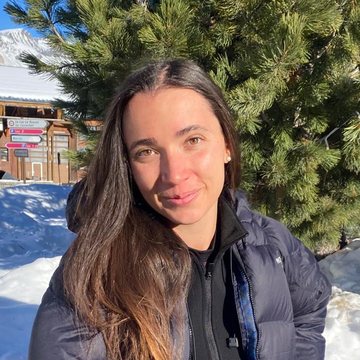
Camila Medina
Head of ProductMore than 8 years in product management across industries, with a passion for education. Based in Barcelona.
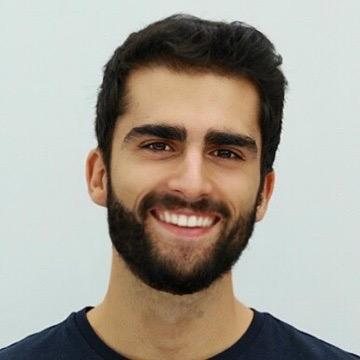
Jordi Campeny
CTOMore than 13 years in tech, building code and web products and leading teams. Based in Barcelona.
Choose a monthly amount. See what the pilot can do.
First, we need to test it in schools. Your sponsorship lets schools join the pilot at no cost, while we measure what changes in the children. What we learn decides how we scale with school licenses.
- Now → February 2027Sponsors and schools confirmed
The Barichara school where we ran the prototype already wants to do it again.
- March 2027Launch and preparation
Each school's story written for its territory, teacher training, onboarding and materials, all ready ahead of time.
- August 2027Schools start
With the new school year, the children begin the seven missions.
Indicative budgets in USD, to be refined together; pesos at an indicative 4,000 COP per USD. A monthly gift is counted over a 12-month school year; each extra year, the same schools continue with a new group of children. About $15,000 a year per school of ~100 children, with full accompaniment: a story created for its territory, teacher training, ongoing support, materials, Action of Hope funds, impact measurement, reporting, and transfer and fiscal-sponsor fees. From year 2, about $11,000 per school: its story and teacher training already exist (we write a new story if the school wants to explore new themes), and a new territory is opened only once. For reference, our first prototype cost ≈ $7,000 per school cycle in 2025. Teachers and Actions of Hope per school follow the prototype (8 teachers, 8 teams).
Tax-deductible from the US, or directly to Colombia.
To Origen Circular
A bank transfer to our Colombian non-profit. Simplest, and the whole gift arrives (minus bank fees). You receive an official donation certificate and a report on how it was used. Not tax-deductible in the US.
Monthly gifts work on both routes. Giving from another country? Write to us and we'll find the best route. Tax treatment depends on your own situation; please check with your advisor.
Before you decide.
How will you know it works?
With the compass, built into the story. Children answer a few questions with faces at the start, tap once after each mission, and answer the same questions at the end: hope for the future, whether they feel they can care for their place, connection with nature, belonging, purpose. The questions are based on PERMA, the wellbeing model from positive psychology, plus connection with nature and environmental agency, and they adapt to age: from 4 for the youngest to 10 for teenagers. Teachers add what they observe, and every Action of Hope is documented. Success means hope and agency go up from start to end, every school completes its Action of Hope, and teachers want to keep going. You receive the results school by school.
How do you protect the children?
Families give their consent before a child joins, under Colombia's data protection law (Ley 1581). We ask for the minimum: a first name and a PIN, never an email or a phone number. Each child's answers are visible only to them, their teacher and our core team. Photos of children are shared only with their family's permission. Children never chat with an AI: AI helps our team draft each school's story, and we review every mission before a child sees it. Field activities are always led by teachers, under the school's usual protocols.
Does it work in rural schools?
Yes, it is designed for them. The missions adapt to multigrade classrooms, where children of different ages learn together with one teacher. We are in conversations with an NGO that runs multigrade education in rural schools across Colombia, to take it to more of them.
Do children spend a lot of time on screens?
No. The screen opens each mission and collects what they found. The work happens outside, in teams, in their own territory, and a shared classroom computer is enough.
Help Áurea Terra reach its next schools.
To have training, stories and onboarding ready for the August school year, we are confirming our founding sponsors before March 2027. Foundational partners launch the program in new schools and help it grow toward financial sustainability through school licenses. Companies, communities or groups of friends can also pool gifts to bring it to one school they choose.
Misión Áurea Terra · Corporación Origen Circular · origencircular@gmail.com · Sources: Hickman et al., The Lancet Planetary Health, 2021 (10,000 young people aged 16–25, 10 countries); WHO, adolescent mental health fact sheet (2025) and key messages.